Ever since George Mack published the high agency essay, it has given recruiters and teams a term to define the kind of talent they want to attract.
This essay has eight of my observations of high agency individuals.
But first… what the fuck is high agency?
A simple way definition is someone who is highly reliable, gets the job done, and knows what job to pick among thousands of tasks.
Obama beautifully explained how high agency people attract attention:
When you ask someone if they’d want to become a high agency person, they will most likely say yes. Because who doesn’t want to be good, reliable, and important at what they do.
But how? We don’t know.
Short story:
Back in the ’60s, courts were constantly banning books and movies, desperately trying to figure out where to draw the line between cool adult art and illegal filth, aka porn.
So this theater owner gets busted in Ohio just for showing a classy French movie that had lovey dovey scenes. It goes all the way to the Supreme Court, and the judges are totally losing their minds trying to write down a legal definition for hard-core porn.
Finally, Justice Potter Stewart writes his opinion and basically says that he’s not even going to try to define it, and maybe he could never do it intelligently anyway, “but I know it when I see it”.
I guess High agency is the same.
It is hard to describe what recipe turns you into high agency. But when a high agency individual is in the room, you notice.
Which is why I wrote this essay.
There is a high possibility my writing might sound like advice. I want you to know it’s not.
Because I am not a high agency person yet. I have some of the qualities, but I am nowhere close to calling myself high agency.
In the last 6 years, I have been fortunate enough to meet and spend time with the most talented founders, marketers, and managers; thanks to Twitter/X. This essay documents my observations of the time spent with them.
Most of what I share today are my learnings from speaking with high agency employees and founders, reading their posts, or silently observing them.
Now pay attention. This is a list of common qualities I noticed in high agency people I have worked with.
You close loops
I first encountered the concept of “Closing Loops” when I was on a walk with my friend, Sreekar.
He mentioned how he opened many loops at his work but didn’t close them, and that was his biggest learning of the quarter.
Sreekar is a content marketer and he started many initiatives in his company. New internal tools, AI agents, marketing campaigns, etc.
For example, he built a bot that constantly monitors their competitors and sends alerts to his company. Okay cool, then what? No one really spoke about these alerts and after a point, the alerts became non-existent.
When Sreekar realised his work was low agency, he set up a 30-minute call once a week to discuss the alerts. Now the team often talks about competitors and see if they can do something about it.
He started a loop. He left it unmonitored. Now that he has closed it, he gave the loop meaning and his teammates clarity.
Closing loops doesn’t always mean successful missions. Starting side hustles and deciding to not work on them anymore also counts as closed loops. It is ending a journey that’s started, even if the destination was not what it was meant to be. You do this mainly to free space in your head, to not get overwhelmed by the tasks on your to do that you’d never touch in near future.
Closing loops gives clarity to people who work with you, and peace to your mind.
My friend, Aditya, shared one of my favourite videos on closing loops. You should watch it.
You are okay to get embarrassed
I’m the kind of person who does it all on his own. I don’t want to bother people at every step of the process. I don’t want to show bad work. I don’t want to share something that I feel is not ready. But I noticed how sharing processes and asking questions helps you achieve refined outcomes.
This of course doesn’t mean you ping people for questions that are one Google or AI search away. But present your progress and be okay with your work not being perfect.
Story time. My manager noticed I am a perfectionist. That I won’t submit my work until it feels perfect to me. Despite that, there were revisions and misalignment with what my team expects of me.
He then told me, “Help us help you, Vikra.”
It reminded me of Scott Adams’ phrase in Refine your Brain. Embarrassment is an investment.
From personal experience, it was uncomfortable to show work that isn’t perfect in my head. But the more I shared imperfect work, the more perfect the end outcome was than I ever imagined.
I like Tushar for how unhinged he is about publishing the MVP (fancy word for startup people for the work that is not perfect, but ready enough to let people use it).
He ships the scrappiest of work and only refines if people show interest in it.
Communication not only drives clarity, but accountability.
I asked founders running $10-50k MRR software businesses, “What are some qualities you expect from your team members?”
All of them mentioned constant and good communication.
Back in the day when I heard about communication, I thought it was for clarity. Because founders and managers handle multiple tasks, their life will get easier if you give constant updates.
But that’s just one way street. The other side of the coin is it makes you accountable.
Months ago, I only communicated what I had done. Sometimes I delayed communication because I know the tasks should have been done were not. I escaped accountability.
Today, I update what I did each day. Even if I didn’t finish what I am supposed to, or at the speed I’m supposed to. This felt unnecessary in the beginning, but it held me accountable. Every night when I post updates, it’s a reality check of “Have I given my best and prioritised the right tasks?”
When you make it hard for yourself to escape accountability, you find the right tasks to prioritise.
Outcomes over activities
One of my colleagues once told me, “We measure quality of work by outcomes and not activities.”
It’s a powerful concept if you internalise it, and it is a pattern I have been noticing in all the high agency people.
The task is done for them when they achieve the outcome. They never celebrate, “Hey look at this ten step AI workflow I have created.”
They celebrate, “Hey, I got this done,” or, “Hey, this is the result that it was able to produce.”
It’s not about hard work not being rewarded, but knowing what matters in business and focus on achieving outcomes from your role.
To my friends outside India, this is quite contrary to how most of the Indian institutions work.
For them, if you achieve something easily, you are somewhat considered not worthy of your achievement. For some reason, hard work has to be associated with outcomes, which takes time to unlearn.
TL;DR: Don’t worry about activities; but outcomes. Some people get there with hard work, some with smart work. You do you, but get to outcomes.
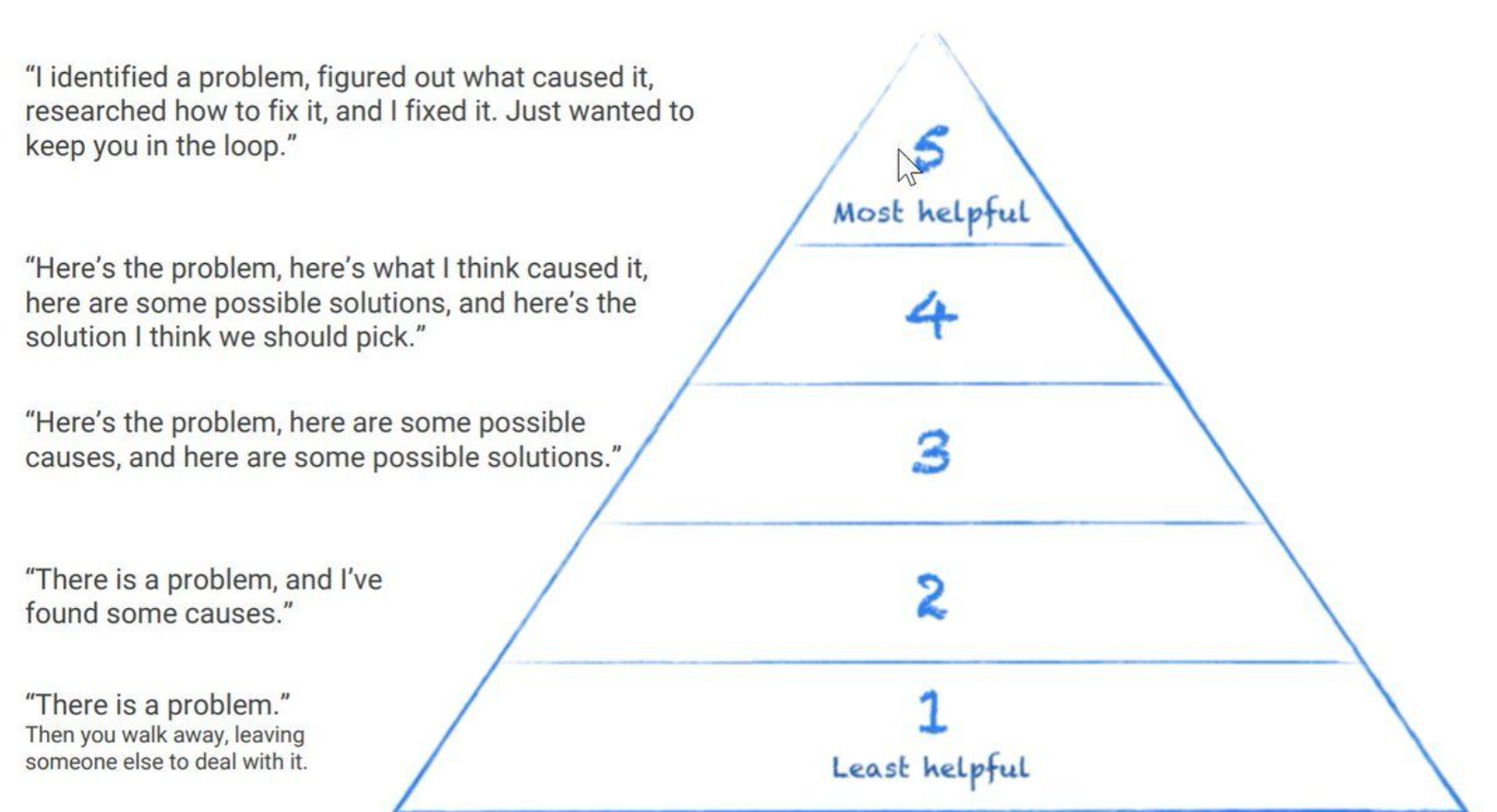
State problems AND solutions
At every point, high agency individuals make life easy for stakeholders.
Good founders make life easy for customers. Good employees make life easy for managers. Good leaders make life easy for their teams …and so on.
I could go on and on about this, but this image should do:
Do what you said you will do
Do what you said you will do. My friend Rahul (I’ll keep quoting a lot of my friends in this essay) said this to me in mid 2025 and it’s one of my favourite frameworks.
Rahul himself is super high agency, and his thesis is: When you do what you said you will do, you build trust and show you are a reliable person.
Be it in a job or business, it translates to trust and reliability.
“When losers lose, they change the goal”
My friend, Shubh (Man, I love his Twitter/X) posted about professionals who are the exact opposite of high agency.
In his own words, if you want to become a high agency individual, avoid this:
2 things incompetent team members will almost always do:
- They’ll share a lot more irrelevant metrics than needed, hopefully to steer attention away from their primary KPI
(Especially when using ai)
You might’ve seen this before by the way - the person is supposed to measure and report 2-3 key metrics.
The metrics primarily in their control that the org cares about.
But they’ll spin up and share 10 other metrics and numbers.
That doesn’t really matter by the way - but the fact that they’ve been presented in a dashboard with some pretty charts makes you believe something important is happening.
They’ll say that the key numbers are down but hey look! this totally irrelevant number you don’t care about, that has some improvement.
- If they continue to fail at their primary target, they’ll try and change the KPI measured and how it’s measured entirely.
You set up a system - number “X” is what matters.
This person will not be able to show progress in number “X” and they’ll eventually either change how it’s measured or what it signifies.
They’ll try and come up with a separate way that seems like X but isn’t.
And try to redeem themselves with an easier challenge. Or do both.
Sense of urgency and Promptness
There is this reel where an entrepreneur mentions she is successful at her business because she is not richer, smarter or better than anyone else, but because she is faster.
All high-agency people I’ve met have a great sense of urgency and promptness. If they know something needs to be done today and not doing it would make it a blocker for teammates, they would not postpone it.
The most prompt person I met in my life is my Dad.
At the time of writing this essay, I am 27 years old, and in ~24 years of my consciousness, I have never seen my Dad procrastinate. I have never seen him say, “Hey, I don’t feel like doing this today, I’ll do it tomorrow.”
If it can be done today, it’s done today. If it can’t be done today, it’s done tomorrow. Done. Period.
My mom and I never worry about anything dad is up to. I don’t think we ever followed up. We never had to.
He is a big aspiration for me. If I get at least 10% of my Dad’s promptness, I’ll be content with life. I think I’m at about 3% today.
An extension of the same concept is: “There is no almost done or 90% done. It’s done or NOT done. There are no open loops. There are no ifs and buts.”
That’s my time. Good day.
Write to me if you disagree or can improve this essay. I’m here: vikra@dopecontent.in