I spend at least 30 hours a week reading about new AI developments, enterprise use cases, and building agents, intelligent workflows to make my job simpler.
I wouldn’t dare call myself a power user yet, but my fair share of AI use makes me wonder, “How do I stay in charge when I am constantly outsourcing my mind?”
You might have seen tech gurus argue don’t outsource your thinking, use AI for operational tasks, blah blah. I agree you should be in charge and not the tools, but we can’t deny how good AI is at thinking for us. Maybe not the entire solution, but brainstorming with AI helps you see the blind spots you wouldn’t have noticed otherwise.
After speaking to friends much smarter than me, using AI in almost every task, and consuming multiple tweets, newsletters, and YouTube videos, I have come to the conclusion that you must be articulate, T-shaped, diverse in your experience and knowledge to win in the AI era.
- Articulate: On the most basic level, prompting. AI understands better if you communicate clearly (like all relationships????)
- T-shaped: If you’re only a specialist in one skill, say content writing, I don’t think the probability of landing good roles is as high as it used to be. Now brands expect you to write in multiple formats or handle more roles than just writing.
- Diversity: When people say unique, all they mean is you mix 2-3 things in a way many people wouldn’t. To do that, you need access to multiple knowledge sets.
So… What are the daily tasks you already do that you can multiply intentionally to become articulate, T-shaped, and diverse?
1. Talk to smart people
If not for my friends, I would still be using ChatGPT’s free plan and arguing AI is shit, while a much smarter marketer would replace me.
My biggest advantage is my friends are way smarter than I am. I talk with them about my work, tools, processes, and ideas, and they counter with 10x better ways to approach the same problem.
It’s a blessing (with an imposter add-on, but net net it’s a positive I guess)
When you share ideas, you open yourself to the embarrassment investment. It shows you where you are and how long the road is to share a room with the people you admire.
You gain clarity, multiple POVs, and, most importantly, you will learn to separate signal from noise.
Meet people in person. Join online and offline communities. DM on social media. Speak with people from different backgrounds, ages, locations, etc.
Internet made people a DM/email away. You just need to ask good questions worth their time. If you’ve never tried DMs or emails, get ready to be surprised by how helpful netizens actually are.
2. Write essays
Writing is thinking. Writing helps you differentiate between what you think you know and what you actually know. It shows the clarity gap, and, if done right, helps you bridge it.
When I say essays, I don’t mean all the serious stuff. It could be long IG captions about your partner, your morning pages in a diary, or a cute blog with 9 visitors a month, like mine.
Fuck it, you don’t even need to publish it. The entire point is to put your thoughts into words. I prefer my work to go public because I am always curious about the comments and disagreements I get. Opens up POVs I haven’t thought about.
Also, a minimum of 500 words because nuance is where insights lie.
3. Read books
Probably the only knowledge set today without ads, algorithms, and distractions.
I noticed my attention to reading long-form has decreased because of summaries, reels, and YouTube videos, which are all great and worth my time. As much as I’d like to romanticise patience, it’s not a bad thing to gain knowledge by consuming short-form content.
But the biggest advantage of books is that they give you space to imagine and move around in your mind.
You can scroll your thoughts away on reels. Next five recommendations scream “click me” on YouTube. Most blogs you read say “you might also like…”
But books let you wait. They let you take your time and build on your thoughts. That’s why I switched to paperbacks. So I can observe my thoughts without algorithms directing what to think next.
4. 15-minutes of doing nothing
I don’t know if you noticed this too, but most people around me, including myself, have become allergic to silence.
I am doing admin work? Need music in the background. Watching TV? Need phone. One screen isn’t enough. On a walk? Need music or an audiobook.
These aren’t essentially bad habits. Music helps me relax while doing the boring admin tasks. I can text my friends while watching cricket. I can learn new concepts while meeting the step count. It’s cool.
My problem is with how hard it is for us to sit and do nothing. No agenda, no plans, no goals, no productivity trackers, just maybe sit on a terrace and see a mango tree. Or sunset. Or birds fly.
The curse of ambitious people is they can’t sit still. They don’t always do meaningful work, but they’d like to indulge in an illusion of work. This is me. But I also recommend spending 15 minutes a day without devices or an agenda, and notice the difference it makes in your life.
5. Build offline hobbies
At this point, I might sound like a broken tape recorder.
But offline hobbies are a great way to zone out. AI era will become (if not already) about managing multiple agents at once. Given the speed of output, you’re always in high alert mode to respond with more prompts, questions, and just doing more.
If you have noticed, ever since AI became mainstream, your work hours might have actually increased.
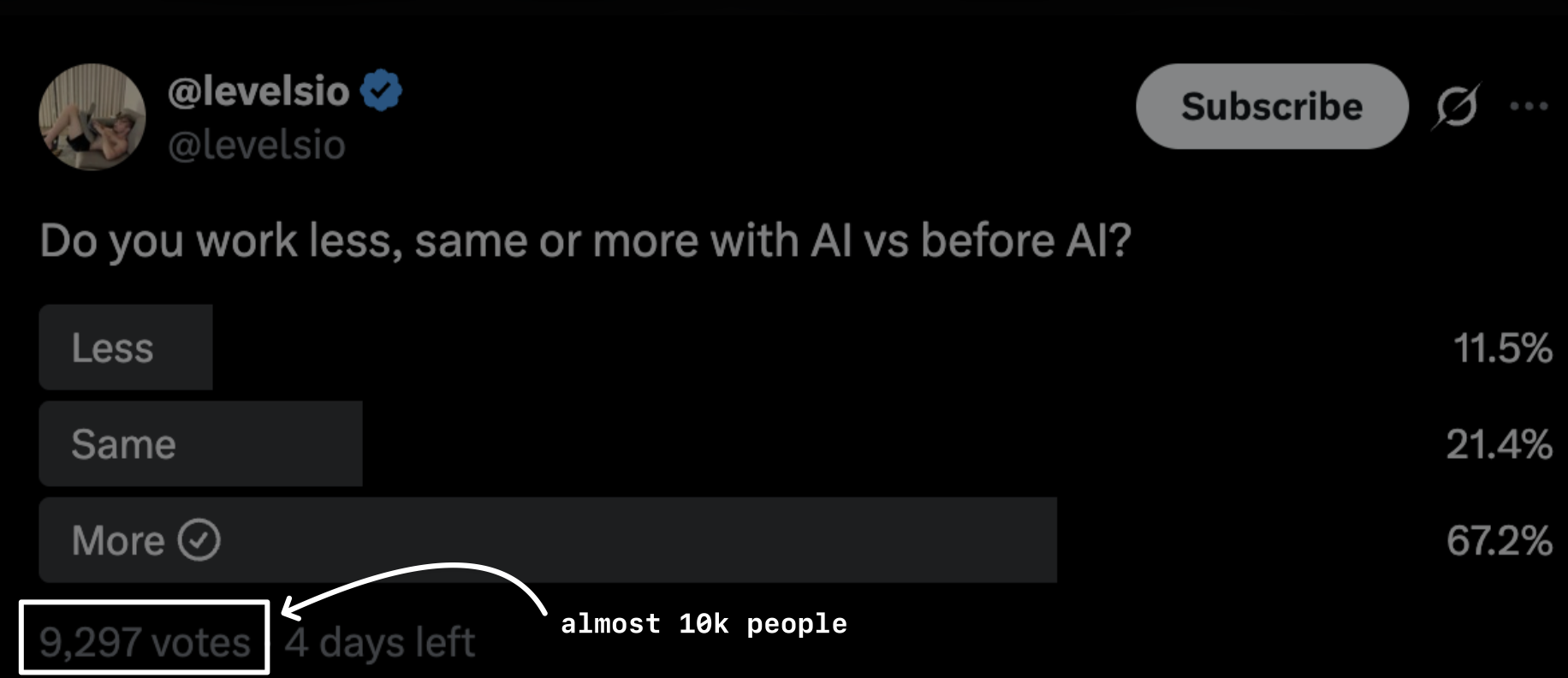
Your endurance has limits and you will feel fatigue at some point irrespective of how much you love your work. Fatigue kills thinking.
I play sports, repair watches, build LEGO sets, brew coffee, and have a bunch of other hobbies. It helps me zoom out of the AI/work bubble and zoom in later with a fresh perspective.
Also, for the sake of it, hobbies are fun!
6. Always learn something new
Neuroplasticity is one of my favourite concepts. It’s about how the networks in your mind rewire and tap into new corners when you learn a new skill. Like a language, instrument, sport, etc. You should look it up on YouTube. It’s super duper interesting.
Every new hobby taps into different areas of the nervous system. So each time you learn something new, you’re unlocking a new side of your brain.
The things you learn don’t have to be productive or useful. They just need to be new and make you curious enough to spend time. Observe your curiosity.
At the time of writing this essay, I was in Dharamshala and attended a stand-up comedy writing workshop. I learned to write jokes and even performed a two-minute set.
I might never write a joke again in my life. I might be super bad at comedy. But now I have a new insight into how I view the world. I keep searching for setups and punch lines.
On a tangent, this also helps me learn to learn. I can only be good at a few things, but attempting to learn multiple new skills gives me a framework to learn the next new skills.
I once read on Instagram,
“I have noticed people who were athletes carry something different in how they approach hard things. Not because sport builds character exactly. But because they have a physical memory of being uncomfortable and continuing anyway. That memory is a resource. That’s why some people push through while others can’t.”
When you learn new things, you’re building a memory to reuse in different situations along with the skill.
(You can see my tiny experiments on my now page)
Well… that’s everything I could think of. My criteria were “What are the most basic things most of us already do that could be multiplied?”
If there’s anything I could upgrade or add in this essay, feel free to DM or email me.
To thinking in the age of AI!